Posts tagged: EPA

Flex Fueled: The Current Crop

E85 capable vehicles available today.

There is a segment of American drivers who are interested in buying a car capable of running on a strong blend of ethanol and straight gasoline. For them, utilizing a home grown fuel is better than feeding the foreign oil habit, their personal declaration that American energy independence is possible.

Ethanol Ready

All cars built today are able to run on E10 fuel — 10 percent ethanol, 90 percent gasoline; but few can run on E85 fuel — 85 percent ethanol, 15 percent gasoline.

That’s because certain corrosion prevention measures need to be taken to protect the fuel line and gas tank. When in place, placarding in the area of the fuel tank and a notation in the owner’s manual signifies that fueling with E85 is an option.

Oil Dependency

E85 enthusiasts love the fuel for a few other reasons including enjoying a slight boost in performance, low prices where widely available and the support it offers farmers who grow the corn which comprises the fuel. But, there is a loss of fuel efficiency, somewhere between 20-30 percent which makes E85 unattractive for many. And, the fuel is hard to find in areas where corn is not king, diminishing the attraction of E85 further.

For the 2010 model year, a number of vehicles are E85 capable. Let’s take a look at the run down:

Chevrolet — Select Malibus with the 2.4-liter four-cylinder engine paired with a six-speed automatic transmission or 3.5-liter V-6 paired with a four-speed automatic transmission. HHR FWD or Panel FWD with the 2.2-liter four-cylinder engine paired with a five-speed manual or four-speed automatic transmission. Chevrolet Impala equipped with a 3.5-liter or 3.9-liter six-cylinder engine paired with a four-speed automatic transmission. Various Silverado, Avalanche, Tahoe, Express and Suburban models. Lots of Chevrolets! Indeed, Chevrolet claims to have produced 2.5 million FFVs to date.

Ford – Front- and all-wheel-drive Fusion with 3.0L V-6 engine paired with a six-speed automatic transmission.  Ford Escape in 2WD or 4WD with 3.0L V-6 engine paired with a six-speed automatic transmission. Select F-150 and Expedition models.

Chrysler — Sebring hard top sedan and convertible with 2.7-liter V-6 paired with a four-speed automatic transmission. Town & County minivan with 3.3-liter V-6 paired with a four-speed automatic transmission.

Dodge — Avenger with 2.7-liter V-6 paired with a four-speed automatic transmission. Grand Caravan minivan with 3.3-liter V-6 paired with a four-speed automatic transmission. 2WD and 4WD Dakota and Ram pickup trucks outfitted with a 4.7-liter V-8 engine and paired with a five-speed automatic transmission.

Other GM — Buick Lucerne equipped with a 3.9-liter V-6 paired with a four-speed automatic transmission. Numerous GMC models paralleling offerings made by Chevrolet trucks. Various Cadillac Escalade models.

Other Ford — Select Mercury Milan, Mariner and Grand Marquis models. Lincoln Town Car and Navigator.

Foreign ManufacturersNissan, Toyota, Mazda and Mercedes models.

FFV vehicles were offered as far back as the early 1990s and new models are being added or existing models subtracted depending on model year. Check with the manufacturer to find out affected models or visit the Environmental Protection Agency list for more information.

Hyundai Santa Fe: New and Improved

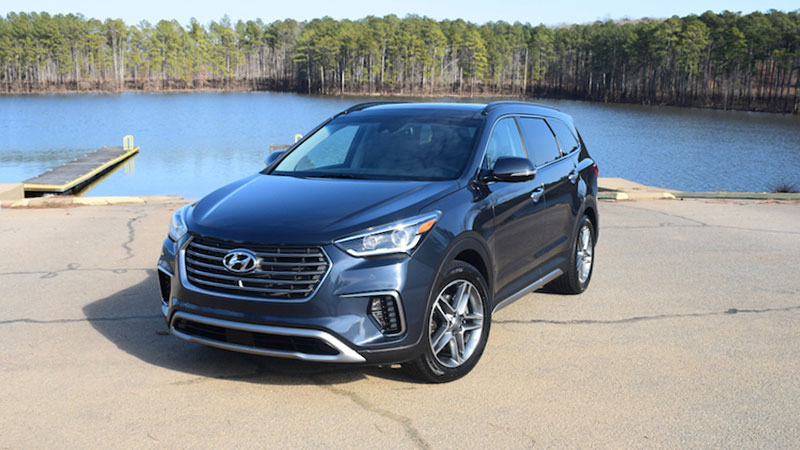
Hyundai Santa Fe

Midsize sport utility vehicles are a dime a dozen. Or at least it seems that way. Mostly ever car manufacturer offers at least one model, a segment featuring SUVs with two or three rows, typically seating 5 to 7 passengers.

The Santa Fe is also part of the sub-segment of vehicles known as crossovers. These SUVs ride on a car chassis, in this case the one underpinning the Hyundai Sonata, instead of a truck chassis as traditional SUVs do. With crossovers you can get optional all wheel drive capabilities, but as far as off-road work light duty is as far you would dare to go with these models.

Late Arrival

For 2010, Hyundai gave the Santa Fe a mid-cycle refresh, a late one at that. The 2010 model was introduced in January, months later than when new models are usually introduced. Thus, EPA gas mileage figures have only been posted for the base trim package.

The first generation model was introduced in 2000 for the 2001 model year, with the second generation Santa Fe rolling out six years later. Now midway through its lifespan, the Santa Fe enjoys several important tweaks including the following:

  • Exterior updates including changes to the grille, fog lights, bumper, and body trim. New wheels are evident, available in 17- or 18-inch sizes.
  • On the inside, the third row option is no longer available, which will put the Santa Fe at a disadvantage to similar vehicles including the Toyota Highlander. Third row passenger space was limited anyway as the Santa Fe is smaller than its competing models.
  • Where the Santa Fe lacks in passenger seating, it gains in entertainment as the Hyundai now includes a number of important features such as audio controls on the steering wheel, Bluetooth connectivity, and a USB iPod interface. Seats have been upgraded and if you choose higher trim level packages, a power driver’s seat is available as are heated seats.
  • Under the hood, the Santa Fe has two new engine choices. A more efficient 2.4L I4 engine is now standard while a 3.5L V6 is optional. The base engine with standard trim is paired with a six-speed manual transmission while all other trim and engine packages include a six-speed automatic transmission.

According to the EPA, the base engine with manual transmission returns 19 mpg city, 26 highway. Fuel economy figures for other trim levels should be released within the next week or two.

Safety Upgrades

Last but not least are a number of safety upgrades including active head restraints for the front seats, antilock brakes and traction control, and rollover sensors which work to deploy the side impact airbags when needed.

Hyundai Santa Fe
Hyundai Santa Fe
Hyundai Santa Fe
Hyundai Santa Fe

Source: Hyundai Motor America

Higher Gas Prices May Lead To Hybrid Surge

Ford sells four hybrid models including this Mercury Milan Hybrid sedan.

Ford sells four hybrid models including this Mercury Milan Hybrid sedan.

You might think that gasoline was retailing for above four dollars a gallon the way that hybrid sales have been acting of late particularly for one automaker.

Ford Hybrid Demand Surges

On the strength of its release of the Ford Fusion Hybrid and Mercury Milan Hybrid this past spring, the Ford Motor Company is enjoying a 73% increase in hybrid sales for the year. Couple these midsize sedans with the automaker’s two compact crossover hybrids – the Ford Escape Hybrid and Mercury Mariner Hybrid – and you can see why hybrid sales are on the increase during a time when gas prices are flat and overall sales abysmal.

With oil moving above $75 a barrel and the world’s economy on the mend, demand for fuel will only accelerate, perhaps returning gas prices to levels last seen in Summer 2008. While this forecast bodes poorly for the typical driver, it will likely cause many car shoppers to to look for vehicles which offer outstanding fuel economy. And with an Environmental Protection Agency (EPA) mileage rating of 41 city/36 highway, the five passenger Ford sedans offer plenty of interior room for the fuel economy.

Conquest Sales Delight

Most telling about the way that the Fusion and Milan hybrid models are performing is just who is buying these cars. Ford reports that sixty percent of Fusion Hybrid sales are from non-Ford owners, with more than half of those from foreign makes. Toyota and Honda owners make up more than half of those conquest sales, a very good indicator of just how well these cars are being received.

Ford shocked the green world earlier this year when the EPA released its mileage estimates for the hybrid sedans which easily topped the industry standard-bearing Toyota Camry Hybrid whose own ratings are 33 city/34 highway. A quick survey of the market shows that around town the Fusion Hybrid beats mostly everyone including the diminutive Smart Fortwo, Volkswagen Jetta TDI and the Honda Civic Hybrid.

Fleet Uses Surge

Part of the reason why demand for Ford hybrids is surging has everything to do with government and taxi industry fleets welcoming these models.

In San Francisco, more than two hundred Ford Escape Hybrid taxis ply the streets of this hilly city by the bay. Fifteen of those models have pushed past 300,000 miles and are now being replaced, having first been put into service in 2005. That is a strong tribute to the durability of these hybrids and should dispel worries among buyers that the technology can’t function beyond 100-150,000 miles as originally thought by some.

The New York Taxi fleet is the largest in the world and with some 13,000 plus hybrid models in service it makes for a good indicator on how these vehicles perform in all kinds of conditions. As the saying goes, “if you can make it in New York, you can make it anywhere,” Ford’s contribution to the fleet is 2000 Ford Escape Hybrid models strong. Like San Francisco, a number of the earlier models have pushed past 300,000 miles and will soon be replaced by new Ford hybrids.

Ford Knocking On The Door

For Ford, the auspicious growth of its hybrid program puts its sales in the range of Honda, the number two retailer of hybrid vehicles in America. While Toyota remains far out front of the pack, Ford is proving that demand for its vehicles remain strong and that it can beat even the industry leader at its own game, taking sales away from its chief competitors and increasing overall manufacturer market share as well.

References

Ford Escape Hybrid taxis demonstrate durability on New York streets

San Francisco’s hybrid taxis prove their worth

Photo Credit: Ford Motor Company