Posts tagged: gas mileage

Fuel Efficiency Adviser Helps Drivers Conserve

Claiming to be able to improve your fuel economy by as much thirty-three percent, the makers of the Fuel Efficiency Adviser have developed a product that they say can pay for itself in as little as twelve weeks. I got a hold of the product and gave it a two month test.

Claiming to be able to improve your fuel economy by as much thirty-three percent, the makers of the Fuel Efficiency Adviser have developed a product that they say can pay for itself in as little as twelve weeks. I got a hold of the product and gave it a two month test.

When I was asked this past May if I would be interested in testing a product called the “Fuel Efficiency Adviser($159.95, www.fuelefficiency centers.com) I didn’t hesitate to jump at the opportunity. After all, if a product promises to help me increase my gas mileage, then what have I got to lose?

Before the product was shipped to me I learned that it was something that I could plug into my car’s OBDII port where it would analyze my driving habits. Since I work from home, my driving is fairly limited, but I told my product contact that once I got a good feel for their “adviser” I would post my findings to this site. After two months of testing, I have a good feel for what this product does and does not do.

Improved Driving Habits

Sold under the tag line, “Drive Smart | Drive Green” it is understandable that the focus of the adviser is to help conserve fuel. Claiming to save up to 33% in fuel costs seemed like quite a stretch to me, but then when I plugged it in and became aware of just how much fuel I was using, I knew that I could conserve if I paid closer attention to the way that I drive. In other words, if you’re a lead-footed driver as I can sometimes be, you’ll find ways to avoid jackrabbit starts, ease up on the accelerator and practice other good habits.

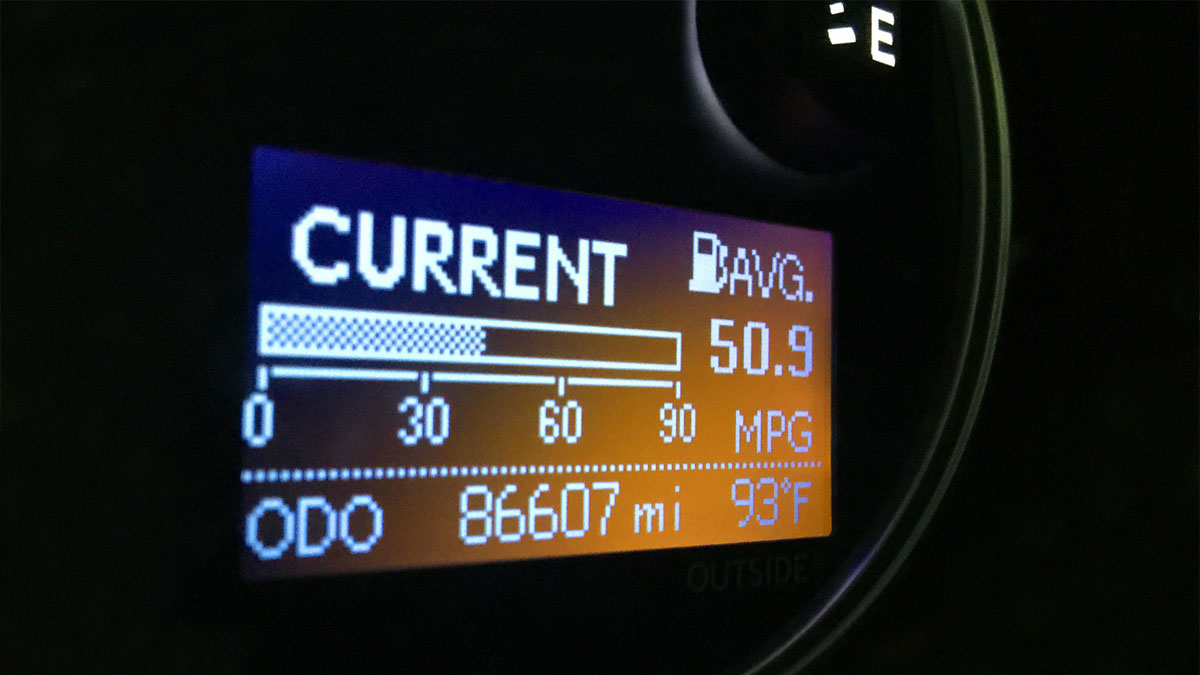
The Fuel Efficiency Adviser features a display panel where you can see your miles per gallon, your average mileage per gallon, current trip costs and costs so far today. In addition to a trip computer and digital gauges, the adviser offers a scan tool that reads and clears trouble codes, indicates trouble source and level of condition, turns off the “check engine” lamp and shows completion of emissions test and readiness to pass OBDII emissions testing. Honestly, I only used the adviser for fuel economy purposes as I was most interested in seeing how I could increase my fuel mileage.

Getting Better Gas Mileage

The car I chose for this test was a 2001 Dodge Neon SE. An older model with just over 41,000 miles on the odometer (as you can see, I don’t get out all that much), my Neon with automatic transmission gets a revised EPA fuel economy of 21 city, 28 highway. Those figures were adjusted downward from when I bought the car, but are fairly accurate in my opinion.

Around town, the adviser initially showed that my fuel mileage wasn’t all that impressive, rating in the high teens while barely topping 25 mpg on the highway. Yes, disappointing numbers for such a small car, but once I got the hang of how the adviser worked (and I began to ease up on the gas pedal) my numbers improved. Sharply too.

Finding My Driving Sweet Spot

As I mentioned, I don’t drive all that much but there were a few occasions where an extended trip of thirty minutes or more did take place. On one trip, my gas mileage improved steadily so much so that my top mpg was 32.5 at one point. Keep in mind that your fuel numbers can fluctuate wildly as it depends on whether you’re idling, driving local or keeping a steady speed on the highway. FYI, my optimum highway speed was 62 mpg before my fuel numbers began to drop.

I can see where some people might say that the Fuel Efficiency Adviser isn’t for them as they can realize similar savings without this sort of aid. But, I also can see where it can teach drivers to maximize their fuel economy by practicing good driving habits a step that will improve their gas mileage, reduce emissions and more than pay for the cost of the product. Count me among the latter group of drivers!

Equinox Gas Mileage Should Encourage Cruze Faithful

The Chevy Equinox offers a strong hint at what is come for the 2011 Chevy Cruze, especially concerning gas mileage.

The Chevy Equinox offers a strong hint at what is come for the 2011 Chevy Cruze, especially concerning gas mileage.

Last August, when General Motors first began to really push the Chevrolet Cruze by having media specialists show up at a gathering in Lordstown, Ohio, the plant where the car will be assembled, GM indicated that highway gas mileage for the car would be quite high, with numbers as high as 45 mpg mentioned. Though I was invited to attend the event, I had a prior commitment, but I was still able to closely follow everything that was being said about the Cruze.

Ultra High Fuel Economy?

At the time, I wondered if GM was stretching the Cruze numbers, given that even the diminutive Smart Fortwo gets only 41 mpg on the highway. True, a generation ago it wasn’t too hard for the smallest cars on the road to get north of 40 mpg, but that was before emissions testing got real tough and when cars didn’t come with airbags and other heavy equipment items. I just wasn’t confident that GM was accurately portraying how well the Cruze would perform fuel economy wise.

All that began to change for me when the fuel economy numbers for the Chevy Equinox were recently released. Powered by a 2.4L I4 engine that is paired to a six-speed automatic transmission, the 2010 Equinox delivers 22 mpg city and 32 mpg highway. That latter number puts it at the top of the scale for compact SUVS, besting the Toyota RAV4, Honda CR-V even the Ford Escape Hybrid which delivers 31 mpg on the highway (34 mpg city).

Taking A Look At The Equinox

When I learned that the Equinox scored so well, I began to think that the Chevrolet Cruze with a base 1.4L I4 engine paired to a six-speed automatic transmission, could easily get much higher fuel economy numbers than the heavier, taller and longer Equinox. Though I don’t yet have the specifications for the American Cruze, my thinking is that the engineering for this baby combined with lower curb weight will deliver good numbers.  And, given that GM thought that the Equinox would deliver 21 mpg city and 30 mpg highway, I now believe that highway mileage north of 40 mpg with the Cruze is attainable.

We’re at least a year away from seeing the Chevrolet Cruze hit local showrooms, with GM’s restructuring playing an important part in how that timeline unfolds. However, when the 2011 Chevrolet Cruze does make it to the market, I think that it’ll offer surprising fuel economy, perhaps the best of any five passenger sedan on the market.

Photo Credit: GM Corp.

See also — GM Releases First Chevy Cruze Photographs

AAM Weighs In On Environmental Responsibility

The Alliance of Automobile Manufacturers (AAM) is an organization that consists of many of the major automakers selling cars in the US, focusing on safety and environmental issues as well as presenting a Mazda Verisaunited front with all things automotive. Lately, the organization has had to grapple with market changes coming their way including government mandates requiring that automotive manufacturers produce a greater number of vehicles that get high gas mileage while spewing out fewer harmful emissions.

Quoting Dave McCurdy, President and CEO of the AAM, “An effective climate change policy must be built on an economy-wide approach that involves all stakeholders and emphasizes the wisdom of a national, not state by state, strategy to address climate change.”

The AAM and its member companies understand that they have a responsibility to increase fuel economy and limit greenhouse gas emissions from new automobiles and are committed to being part of the solution to climate change.

Concerning the EPA’s recent analysis of the problem, the AAM says that the subject is complex and requires close study before the organization can valuate how the proposal would impact the industry. The AAM believes that the EPA’s Clean Air Act, which underwent its last major amendment in 1990, leaves out some of the tools and standards necessary to address the global issue of climate change, including requirements on how to balance the economic effects and impacts on U.S. manufacturing jobs along with the environmental considerations. Specifically, the AAM recognizes that the leading climate change proposals in Congress propose using a different framework for reducing carbon dioxide emissions.

What the automakers are doing right now is to produce CO2 efficient autos that use less fuel and emit less carbon dioxide. At the same time elevated gas prices are forcing consumers to do their part as they choose more fuel efficient autos. While the increase in fuel prices and the transition from light-duty trucks to small cars increases the importance for advanced fuel conservation technologies, it does not decrease development costs or reduce the time needed to generate them.

At present, the National Highway Traffic Safety Administration (NHTSA) is in the process of establishing fuel economy standards that will result in a minimum 40% increase in fuel economy and a minimum 30% reduction in carbon dioxide emissions by 2020, requirements which are more rigid than any other industry in the U.S.

The EPA says that autos account for 20% of all man made CO2 emissions in the U.S., but automotive manufacturers are currently offering more than 70 models of alternative fuel autos powered by hybrid electric, clean diesel ethanol and more. Moreover, more than 100 models are already available that achieve highway fuel economy ratings of more than 30 mpg.

(Source: Alliance of Automobile Manufacturers)