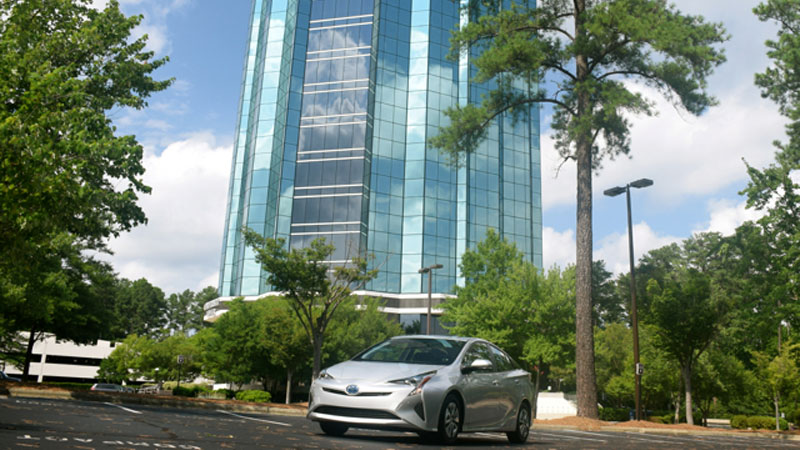
Posts tagged: Toyota Prius

Rumored: No Honda Diesel. We’re Bummed.

Last week, Autoblog relayed the news that Honda’s diesel engine plans were dead. That isn’t too surprising given how long the supposed roll out was delayed.

In November 2007, I published an article titled, “Your 52 MPG Accord Is On Its Way,” believing that Honda was ready to follow through on its plans to offer this vehicle to American drivers. Turns out I had the right idea, but Honda’s plans have since changed or at least have been clarified.

New Plans

Apparently, Honda has reversed course in two areas: the automaker won’t support diesel technology in North America and Honda now believes that hybrid technology can and should be expanded to larger vehicles. And, I’m not saying anything about the Honda’s hydrogen plans which I believe will start coming to fruition around 2015. I test drove the Honda FCX Clarity in November 2008 at the Los Angeles Auto Show.

I won’t rehash what Autoblog shared, limited information that it is, but I can tell you that Honda desperately needs to prove itself in two areas when it comes to vehicle hybridization: the looks of their vehicles and the effectiveness of their hybrid systems. Motor Trend, by the way, thinks the Toyota Prius and Chevy Volt are ugly too.

Ugly Designs

As it stands right now, the Honda Insight is just plain ugly while the hybrid Civic is acceptable. Efficiency wise, the Insight is on par with the larger Ford Fusion but trails the Toyota Prius badly. This after Honda beat Toyota to the North American market with its own hybrid more than a decade ago.

What Honda is looking to do is to improve its current hybrid system and expand it to larger applications. Right now, only partial hybrids are used for big vehicles–namely the Cadillac Escalade and Chevrolet Tahoe–but full hybrids haven’t been developed for the largest models.

Larger Hybrids

In Honda’s case, the Odyssey minivan and its Pilot crossover seem to be good models to target, possibly giving Honda a huge edge in segment fuel economy if they can develop the technology accordingly. Full hybrids run on electric only power for speeds up to 25 or 30 miles per hour (47 mph with the Fusion), but that means vehicles weighing over two tons would need to do so.

As far a complete electrification, Honda doesn’t seem ready to embrace that concept right now, waiting to see how demand for Nissan and BMW electric cars shape up.  Still, the Japanese automaker isn’t about to be left out in the cold and has developed a strategic partnership with a Chinese company to build electric car batteries.

Hot Car Trends In 2010

By Sarah Harris

As Honda, Toyota, Peugeot and Citroen inadvertently make our roads safer by recalling nearly all their faulty cars, the remainder of the motor industry is leaping ahead in 2010 with a series of advanced designs and technologies to make our driving experience even more pleasurable.

corn fieldFord in particular is producing sleeker, sportier looking cars, with their focus (if you will pardon the pun) on bodylines and big wheels – the new Mustang is a prime example of how a car for the “tennies” should look and perform, and this is a trend which is being mirrored by other major car manufacturers – notably Mercedes, Chevrolet and Chrysler. Everybody seems to be including voice activated navigation systems, Bluetooth capabilities and restricted driving modes as standard, and aiming (or claiming) to produce higher levels of car safety, comfort and vehicle security.

However, the biggest leap forward that we are seeing in 2010 is the drive towards environmental awareness and the further development of hybrid cars that are partially electrically driven or use biofuels (E85) as their energy source.

In what was once a market that existed because it was fashionable rather than profitable, increased public awareness of environmental issues and the demand that something be done about it, has lead to a higher volume of hybrid cars being produced and marketed. Hybrid vehicles are now also becoming easier to buy and sell – both in the new and used car markets.

Some of the key issues and perceptions surrounding hybrid cars are still to be resolved (particularly with the Prius!) but steps such as Fords SmartGauge are addressing any remaining public reticence with novelty value. Gimmickry such as the vine leaves on the EcoGuide act as a constant reminder to drivers to drive more efficiently, and advise new converts to eco-driving when to engage battery power in their vehicles.

More efficient uses of electrical power within the vehicle means that batteries are lasting longer and do not require such a long recharging period – in fact most of the recharging is now done by the other functions of the car. As we are seeing cars produce figures of up to 65 mpg (Honda Insight) and well over 40 mpg on average, more consumers are looking at hybrid cars not only for their environmental friendliness, but also their economy and value.

The prices of these vehicles are also coming down. Mazda is leading the way with their hybrid Tribute series costing little more than a gas driven version, and many of the other Japanese manufacturers are looking at developing similar no-frill, economy models. The government’s introduction of tax credits for up to 30% of the purchase price of hybrid cars, or converting existing gas powered ones, will help cushion the blow of purchasing an environmentally friendly vehicle until such time as the costs reach parity.

As hybrid technologies continue to improve, and become less expensive, the best of the hybrid cars may be some way into the future. There may even be a day when vehicles capable of 65mpg seem inefficient – but not in 2010!

Sarah Harris provides marketing support for Massage Therapy, the premier online resource for those trying to locate a massage therapy school.

Toyota Hybrid Concept Electrifies NAIAS

Toyota FT-CH Hybrid Concept

When it comes to hybrid vehicles, Toyota easily leads the industry. The Toyota Prius is a runaway bestseller, while Lexus offers the only compact premium hybrid model on the market.

Toyota isn’t planning on stopping there, however. The Japanese automaker is looking at bringing out several new models over the next five years including plug-in hybrid, battery electric vehicles, and quite possibly the first production ready hydrogen fuel cell vehicle in 2015.

Toyota FT-CH Concept

On Monday at the North American International Auto Show (NAIAS) in Detroit, Toyota introduced a concept which appears to offer a strong hint at where the automaker is heading. Designed and styled in Europe, the FT-CH is 22 inches shorter than the current Prius model, but within a hair breadth of its width. This is important because although the trend is toward smaller vehicles, encroaching on cabin space changes the pictures. With the FT-CH, Toyota can still offer adequate room while reducing overall weight and increasing fuel efficiency.

“Within the next 10 to 20 years, we will not only reach peak oil we will enter a period where demand for all liquid fuels will exceed supply,” said Jim Lentz, TMS president. “A century after the invention of the automobile, we must re-invent it with powertrains that significantly reduce or eliminate the use of conventional petroleum fuels. One of many alternatives is through what is commonly called the electrification of the automobile. By far, the single most successful example of this has been the gas-electric hybrid.”

New Technologies Emerging

Clearly, Toyota has no intention of completing abandoning gas-electric hybrids. Indeed, the FT-CH or something like it will feature a lithium-ion battery pack instead of the current nickel-cadmium battery pack found in today’s Prius, Ford Fusion Hybrid, and other models. The FT-CH might also operate as a pure electric vehicle or Toyota could use the platform for hydrogen technology.

In any case, the FT-CH as the pictures demonstrate, offer some hints at where Toyota is going with its designs. Take note of the dash and the see through seats: these features are not currently found in any Toyota model!

Toyota FT-CH
Toyota FT-CH
Toyota FT-CH
Toyota FT-CH

Source: Toyota Motor Sales (TMS) U.S.A., Inc.